In this blog post we’re going to explore the actual law changes that led to the “Boris wave” of migration the UK has experienced.
Whilst I’m sure it’s been covered before, I haven’t seen it presented in a way that’s comprehensive, hence this analysis.
Firstly, if you’re not already familiar, the “Boris Wave” refers to the wave of migrants that arrived in the UK during Boris Johnson’s reign as Prime Minister from 2019-2022.
- 2020 – 662,000 migrants (gross figure)
- 2021 – 917,000 migrants (gross figure)
- 2022 – 1,294,000 migrants (gross figure)
Gross and net are displayed below in the graph:
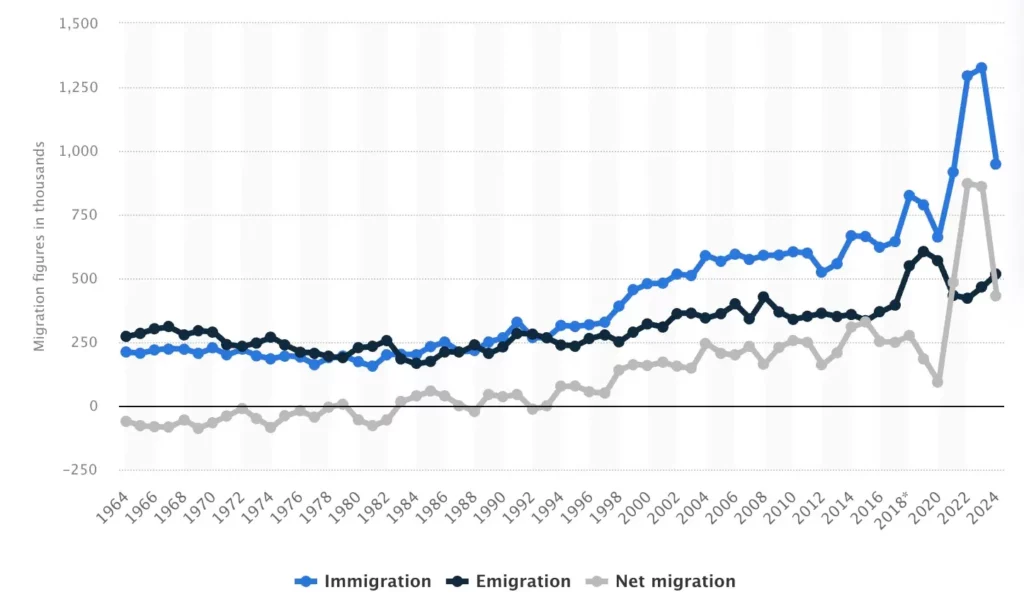
You can see from the above graph that the gross and net levels of migration saw a vast uptick in recent years.
A key point to note that the graph can’t represent:
- The bulk of migrants are now from non-EU countries. Relevance? Non-EU migrants are often more culturally and historically divergent than EU migrants. Also, non-EU migrants have brought more dependents than EU migrants.
Many of the legal changes we’ll look at below are still in place. So whilst Boris’ years were 2019-2022 – his mass migration legacy lives on 🫠

The Law Changes
Multiple laws were changed in order to raise the level of migration. We’ll go through them in somewhat chronological order:
Part 1: The 2020 Act
To begin, a new law was passed called the Immigration and Social Security Co-ordination (EU Withdrawal) Act 2020.
Whilst it didn’t contain specific visa rules, it opened the doors to a restructuring of the system, including the following:
- It repealed Section 7 (Immigration Act 1988) – this previously exempted EU citizens from requiring “leave to enter or remain”. Thus meaning migrants from everywhere were now all part of the same system. To elaborate on this further, it’s not unreasonable to suggest that Europeans are more historically and culturally similar to the British compared with certain other parts of the world. However, from this point forward, they faced the same immigration barriers as everyone else. Whilst this was necessary due to Brexit, the ripple effects would be huge.
- Section 5 of the act gave ministers a ‘Henry VIII power’ – the ability to amend Acts of Parliament by regulation, without new primary legislation, to rewire the statute book around the end of free movement.
Part 2: Immigration Rules changes
Next up are a series of changes to the Immigration Rules:
- Amendment HC 813, which created the “points based system” in December 2020. It made a number of key changes:
- It suspended the annual cap of 20,700 on the Tier 2 (General) visa class, including reducing the requirements needed to apply for this visa. It’s been renamed from “Tier 2 (General)” to the Skilled Worker visa.
- The labour-market test abolition – meaning employers no longer had to advertise to UK workers first.
- The skill threshold cut from graduate-level to A-level equivalent.
- The salary cut from £30,000 to £25,600 (tradeable down to £20,480 using their points system)
- Amendment HC 1248, active July 2021, which added an uncapped, unsponsored two-year work visa with no job, salary, or skill requirement for every international graduate – over 200,000 grants by the end of 2023, 144,000 of them in 2023 alone. This change supercharged the student route that feeds it – with around 275k a year pre-pandemic to ~458-486k in 2022-2023 after this graduate route was announced.
Previously, international students would need to land a job after their tuition in order to stay, but this graduate visa provides a way that they can stay in the UK for 2 further years after graduation with an unrestricted right to work. - Amendment HC 1019, active Feb 2022, which added care workers to the Shortage Occupation List. As we’ll look at later, this led to huge levels of migration, particularly due to the volume of dependents the care workers brought with them, which was uncapped at the time.
The impact on society that this might have would be minimal if migrants were here temporarily, however, the UK has a law called Indefinite Leave to Remain (often abbreviated to ILR).
ILR means that after 5 years on a qualifying visa, you can then apply for ILR. If granted, you can stay indefinitely without need for any particular visa.
The Skilled Worker, Health and Care Worker and family routes all count towards ILR. Time on a Student or Graduate visa does not count directly, but a popular path is:
Student > Graduate visa > Skilled Worker > ILR
So a change that looks like a “two year work visa” is in practice a step on a ladder to permanent settlement, and eventually citizenship.
The effect is that the Boris wave cannot be treated as a temporary spike in migration. Many who arrived in 2021-2023 begin reaching the five year mark from 2026 onwards and become eligible for permanent settlement, with citizenship typically a year after that.
Care Workers
HC 1019 added care workers and home carers to the Shortage Occupation List from February 2022, at a salary threshold of £20,480. There was no cap on numbers and no limit on dependants.
The result was the single largest driver of the wave.
Health and Care Worker visas granted to main applicants rose from around 32,000 in 2021 to 145,800 in 2023. For every care worker, on average 1.2 dependants came with them. In 2023 dependants on this route alone were in the region of around 175,000.
Other Notable Routes
Not all of the 2021-2023 numbers came from the changes above. The Hong Kong BN(O) route (opened January 2021) and the Ukraine schemes (2022) together account for several hundred thousand arrivals. This was done on humanitarian grounds, but the public were not given any choice.
What Has Been Reversed (and what hasn’t)
Below is a table covering some of the key Boris wave changes and what the current status is:
| The Change | Current Status |
| Labour market test abolished (HC 813) | Still abolished |
| Skill threshold cut to A-level equiv. (HC 813) | Partly reversed, raised back to degree level for new applicants from July 2025 |
| Salary threshold £25,600 (HC 813) | Raised to £38,700 in April 2024, then £41,700 in July 2025 |
| Graduate visa, 2 years (HC 1248) | Still in place; government has confirmed a cut to 18 months. |
| Student dependants | Stopped for most courses from January 2024 |
| Care worker route (HC 1019) | Dependants stopped from March 2024; route closed to new overseas applicants from July 2025 |
| ILR after 5 years | Still in place, but extending it to 10 years is under consideration. |
Conclusion / Roundup
The huge spike in migration wasn’t simply an accident – it was a result of changes to the law made by ministers, using powers Parliament handed them in 2020.
The cap was suspended, the tests were removed, the thresholds were cut, and the dependants were waved through.
The partial reversals since 2024 only stop new arrivals; they do nothing about the more than one million people already on the settlement ladder.