I recently came across a movie called An Inconvenient Study. It was put together as a collaboration between the Informed Consent Action Network (ICAN) and Del Bigtree. Del is the CEO of ICAN, and a film producer.
It focuses on a couple of key topics in the debate on vaccine safety:
- Vaccine testing, and the lack of true placebo controlled trials
- Henry Ford University’s unpublished retrospective study of the vaccinated vs non-vaccinated – link

Part 1 – Vaccine Testing
Prior to this movie I’d come across a couple of books on vaccination issues called:
So I was familiar with the idea that the childhood vaccines haven’t actually undergone proper placebo controlled trials.
Instead what has happened is the vaccines have either:
- Been tested without the use of placebo
- Been tested against the existing vaccine that’s being used
The problem with this approach is that without a true placebo of saline water, we can’t know what the real rate of adverse events is.
For example, let’s say there’s HEPB- A (an existing vaccine for hepatitis B) and HEPB-B (a new vaccine for hepatitis B), and HEP-A shows 12 in 100 side effects. I.e. for every 100 people vaccinated, 12 people have side effects.
Then HEP-B shows 13 in 100 side effects. Researchers could say that the number of side effects was only 1% higher than the placebo (13% vs 12% per 100 people vaccinated), which therefore makes the vaccine safe enough to go to market.
In effect, this masks the potential rate of side-effects from the new vaccine. Which makes it seem safer than it actually is.
Additionally – most of the childhood vaccine studies used very small follow-up time windows. With the lowest I remember being only 5 days. WTF.
Part 2 – Vaccinated vs Unvaccinated Study
The second key part to this documentary focuses around a study led by Marcus Zervos of the Henry Ford Health Centre.
If you’re unfamiliar with what the Henry Ford Health Center is, it’s a non-profit health care system founded in 1915 by the Henry Ford of Ford Motor Company. Based in Detroit, Michigan, it’s a network of 13 hospitals and 50,000 team members.
At a high-level the study:
- Compared the health conditions of 16,511 vaccinated and 1,957 unvaccinated children who’s records were present in their system.
- These were children born between 2000 and 2016, making them around ages 9 to 25 currently.
- They ran some fancy statistical analysis to determine the differences between the groups.
I’ll extract some of the relevant details below:
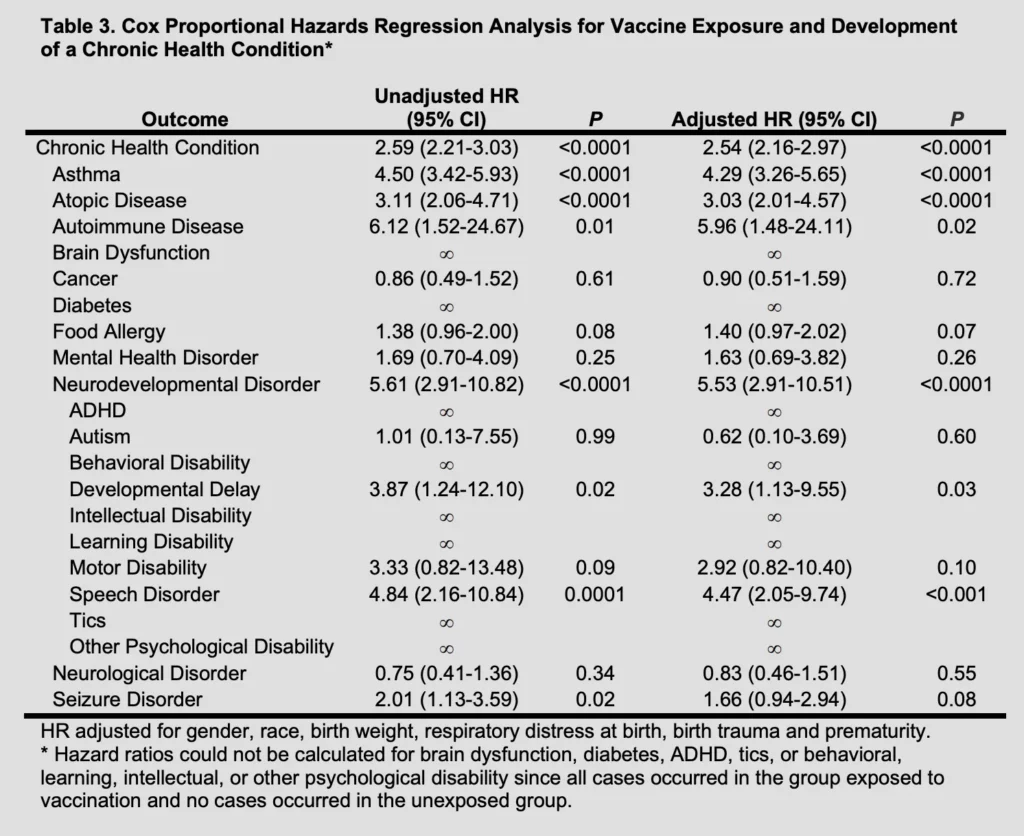
Above is a table that shows the hazard ratio for various chronic diseases for the vaccinated group.
For example, the adjusted hazard ratio of 4.29 for asthma estimates that children in the vaccinated group had 4.29 times the risk of developing asthma versus the unvaccinated group.
The adjusted column represents an attempt to adjust for potential confounders that could be skewing the result.
Below is another interesting graph:
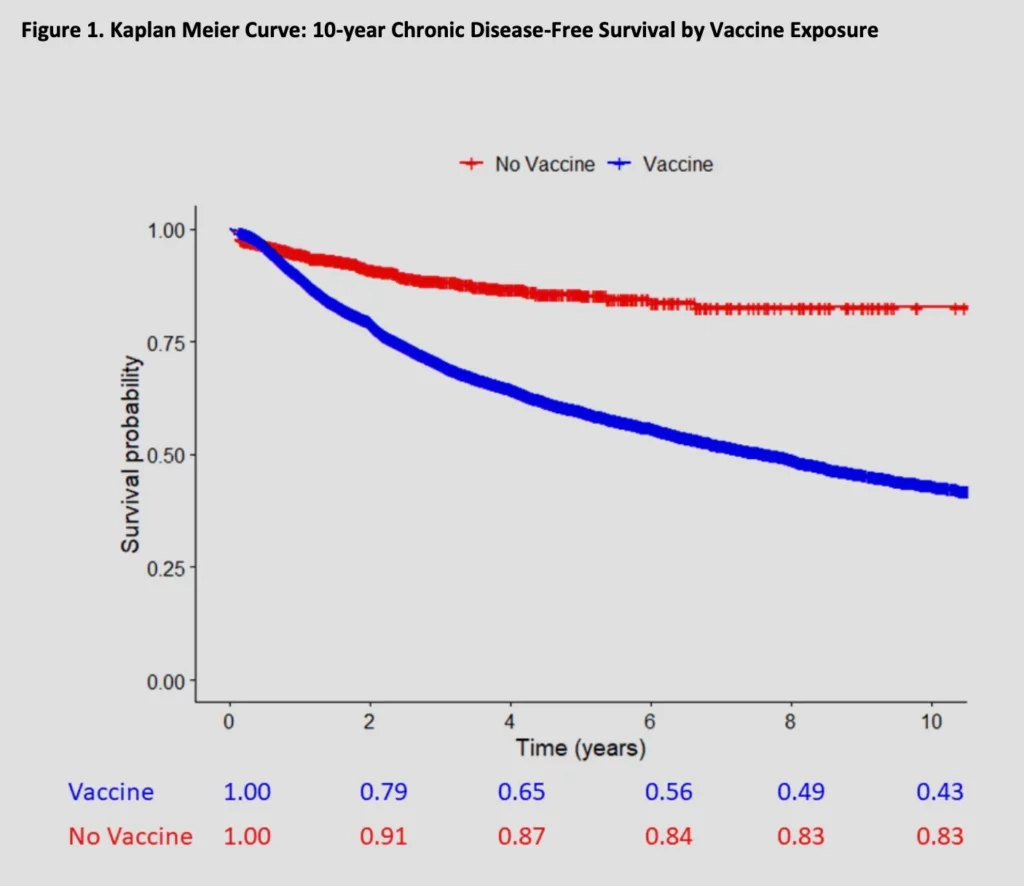
This graph tracks kids for 10 years to see who stays healthy (no chronic diseases).
- Unvaccinated kids (red line): 83% stay healthy after 10 years.
- Vaccinated kids (blue line): Only 43% stay healthy.
In simple terms: it suggests vaccinated kids get chronic illnesses about twice as fast.
Controversy
Part of the movie centers around a dinner that was had with the paper’s lead author Marcus Zervos, which was secretly filmed.
During that dinner, they ask Zervos a few questions:
- Q: Could the study have been done better: A: No
- Q: Do you think the results are important. A: Yes
- Q: Why won’t you publish it? A: Because it’ll get me fired
The Henry Ford center put out a press release saying the study was “immediately shelved upon the first internal peer review because of serious issues with its data and methodology”.
Within the documentary they acknowledge that a restrospective study cannot prove causation, it can only highlight an issue and suggest more research is needed.
Ideally real placebo controlled studies are needed, studies that use saline placebos and follow the results over a period of years to understand the full picture.
The documentary highlights the current push-back to these studies as follows:
It’s argued that it’s “unethical” to use a saline placebo. Thus, for the children’s safety, they have to use real vaccines.
Value of Retrospective Studies
When reflecting on the assertion that it requires placebo controlled studies to prove causation, I thought of some value to this type of restrospective study.
With placebo controlled studies, they will generally focus on one vaccine per study.
However, in practice, the childhood vaccine schedule covers 10s of different vaccines.
Therefore if you want a picture of how ALL those vaccines affect health over a long time period, a restrospective study is a useful mechanism of analysis (in my opinion).
Roundup
Overall I thought the documentary was well put together and raises some good questions.
Whilst it didn’t cover a lot of new material for me personally, I think it’ll be a good medium of content to share with others who are more prone to consuming video content compared to books or scientific papers.